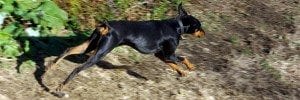
My breed of choice, as most people know, is the Doberman. Like most working breeds, Dobermans are high-energy dogs who like having a job to perform, and bore easily if left with nothing to do.
As long as they have an outlet for their energy, Dobermans are very easy to live with. But on days when it’s too cold/too hot/too stormy/too humid for the dogs to play outside for very long — in short, 3/4 of the year in Indiana — their physical and mental energy makes them a bit… well… boisterous. This is equally true of many other breeds — herding dogs, terriers and Working Group breeds in particular — though most of them are not as climate-sensitive as the Doberman (a breed with a thin coat, very little body fat, and a notorious dislike of raindrops).
When my dogs are too wired to relax, and the weather or time of day prevent me from taking them for a long run, I try to give them as much mental exercise as possible. Anyone who has studied for a difficult exam can tell you how exhausting it is to think hard for a period of time; 15 minutes of intense mental exertion will wear my dogs out as much as a 15-mile run. Mental exercise can come in many forms: Puzzle toys are one of my standbys (though Valenzia can empty nearly any food-dispensing toy within two minutes). Scent and discrimination games are excellent to play in small indoor spaces. Body awareness exercises (learning to back up the stairs, or pick up each foot on cue) also requires a bit of concentration from the dogs, and can also give them a mini-workout as they flex isolated muscles.
But one of the best ways I’ve found to exhaust my dogs is freeshaping. In a shaping exercise, you’re not prompting the dog to do a behavior by giving cues or using a target; you’re starting cold and using ONLY the clicker to communicate what you want the dog to do. This is accomplished by marking successive approximations of the goal behavior — in other words, you’re breaking each part of the behavior down into tiny steps, and clicking the dog for each step. It’s like playing the “Hot and Cold” game, except you’re only telling the dog when it’s “getting warmer.”
The key to successful shaping is to break the behavior down into the smallest pieces possible. This is called “splitting.” This can be a challenge, and is an exercise in creative thinking for most humans. It’s easy for us to say, “I want the dog to pick up the toy” — to us, that looks like a completed behavior. But what is the first step for the dog in picking up the toy? Is it biting the toy? Or, first, moving the head down toward the toy? Or before that, looking at the toy? Or does it start when the dog turns to face in the direction of the toy? All of these are steps that could be marked as part of a shaping session.
A few nights ago, when Valenzia was too wound up to go to bed, I did the following shaping session with her. The behavior is a fairly useless one; I shaped her to retrieve an old metal tea kettle. (I teach a lot of silly pet tricks and non-useful behaviors as training exercises, though sometimes I find a use for them later!) In the video, I’ve labeled the various steps (criteria) that I broke the behavior into to shape it.
Hopefully this will give you an idea of some games you can play with your dog next time he or she is a little too boisterous in the house!
httpv://www.youtube.com/watch?v=VssZYtswOdQ
Just want to say what a great blog you got here!
I’ve been around for quite a lot of time, but finally decided to show my appreciation of your work!
Thumbs up, and keep it going!
Cheers
Christian
I really got a lot from this video but where are the steps when she moves from one criteria to the next? It seems like they are left out and it looks as if she just smoothly moves from one criteria to the next. Weren’t there any sections where you stopped rewarding the current criteria and waited for her to offer a new behavior? For instance, your video goes with constant click/treat from the criteria of touching the kettle to picking it up. Is that the way it really happened or were there a couple of moments of extinction burst? That is the part of shaping that I most would like to see as it is the area of shaping that is the most difficult for me to do well.
Thanks for the wonderful info you post!!
Laura here, but I’ll ask Alena to check in too.
Generally you want your criteria to blend very, very smoothly into one another. The dog may not even realize that it’s making progress. 😉 If you look at 1:30 in the video, you’ll see several behaviors offered very quickly, but Alena clicked only the one she wanted — but it all happened in a second or two. Because she’d built so much momentum in the earlier criterion (nose over handle) it was fairly simple to get the next (mouth open over handle).
As I recall, the video is largely unedited except to add text. Meaning, no large gaps of extinction burst. Those would indicate a too-large jump in criteria and would result in a frustrated dog.
Splitting is usually the most difficult area for *everyone* in shaping, so you’re in great company! 🙂 The key is to keep your “steps” so small that the dog almost accidentally reaches the next one. Your “shaping staircase” should look more like a ramp! 😀
What Laura said. 🙂 There are a couple of short cuts in the video, but most of the things I edited out were brief pauses in the session that I trimmed for time (such as when the dog dropped her treat down a heat vent and got distracted looking for it.) Most of the shaping action progressed just as you see it in the video.
I actively try to avoid extinction bursts with Valenzia; she’s a clinically anxious dog (as you can tell from the constant whining!), and if she gets frustrated by lack of feedback, she becomes overwrought and shuts down. (In fact, I recently wrote a post about that, too: https://caninesinaction.com/2013/03/the-importance-of-precise-feedback-or-stupid-human-youre-doing-it-wrong/ ) But with all shaping, if you split your criteria really fine, you’ll rarely see an obvious extinction burst — instead, you see the dog try something once or twice, and then do it slightly differently. For example, at 0:50 in the video, Valenzia repeats the previously-reinforced behavior (sticking her nose in the kettle) and doesn’t get clicked, so she tries again from a different angle and gets the click when her nose is higher (above the handle). She tries nose-in-kettle again when she goes back, but again doesn’t get clicked until her nose is above the handle.
From my perspective, that’s the point at which I stopped rewarding the current criteria and waited for her to offer a new behavior — but from the dog’s perspective, it’s a very minor step, so she doesn’t need to show a frustrated “burst” of the previous behavior. She simply tries it two or three times, realizes it’s no longer being clicked, and moves on to what IS being reinforced (nose above handle). I didn’t need to fully extinguish putting her nose in the kettle; instead, I just captured the nose in a higher position, and the nose-in-kettle went away. The few non-clicked repetitions were enough to communicate that nose-in-kettle wasn’t the behavior I was looking for, and by immediately reinforcing something else, I still gave her feedback to keep her from becoming frustrated.