Hey, there’s a great new training book hitting the shelves!
Better Together: The CollectedWisdom of Modern Dog Trainers is a comprehensive collection of both practical and inspirational advice from some of the best trainers in the world. Learn the methods of modern dog training through more than 60 articles from 28 experts, specially selected by world-renowned trainer Ken Ramirez.
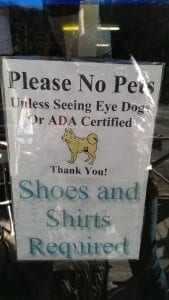
I stopped on my way into the shop to take a photo of the sign on their door. Then I went in, did my shopping, and then gently mentioned during checkout that they might want to revise the wording on their no-pets sign to be more accommodating (and legally acceptable). The shop owners, two women behind the counter, were not aware that their wording was exclusive to many users of service dogs and also not even feasible — there is no such thing as “ADA-certified” — and were eager to learn more. One took notes as I answered questions.
The clerk at a convenience store smiled as Mindy and I approached the counter to pay for my drink. “Your dog is cute, ” she said. “What exactly does she do for you?”
I explained that I was training Mindy, that she didn’t assist me or anyone yet, but that in general it was considered unmannerly to ask a user of a service dog about their medical issues. The young woman hadn’t realized the implication of her question and agreed that it could be invasive.
Most violations of service animal law are not intentional, or even from a position against service animals. Many people use “Seeing Eye dog” as a generic term, without realizing that the Seeing Eye is just one specific organization training dogs for just one specific disability. Saying “Seeing Eye dogs only” is like saying only persons with a specific brand of wheelchair may enter — but their intentions were probably friendly.
Yesterday Mindy and I met some friends at the park for a picnic lunch. I debated and then decided to make it a rare “non-working” outing for Mindy, so she wasn’t in her vest and was free to sniff around and be a puppy. (She gets plenty of puppy time at home, remember, but everyone can take a vacation once in a while!)
Another dog was with us, too, who has spent years recovering from severe fear aggression. She’s remarkably functional now — no one could guess, looking at her, how fearful and reactive she used to be — and she was really enjoying her day, too. Mindy and I respected her space, sitting at the opposite end of the picnic table, but everything was absolutely fine.
It’s autumn, perhaps my favorite season, and I’m keeping an eye on the Dober-thermometer (the tightness of a Doberman’s sleeping curl indicates the overall temperature). So far it’s been mild and lovely, but I expect to see tighter sleeps in the coming week. First snow might be Wednesday. I’ll have to stock up on firewood.
Laev is NOT LOOKING at the caramel apples off the right side of the picture.
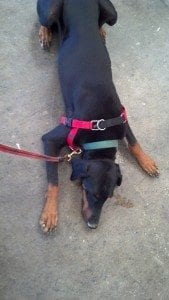
We took a trip to a local orchard, just for fun. Laev was walking happily beside me until we got the caramel apples. Then she sniffed the goodie-laden air, got excited, and promptly flattened herself to the ground. “Look at me! Look at how not-pushy I’m being around the yummies! Do I get one?”
I mentioned in my last post that I wished I had more good-quality photos of Shakespeare. (Most of his work was in the days before there were decent cameras in phones.) So my mom sent…
Today a friend bid goodbye to her dog. And today I made the awful appointment to end Shakespeare’s days with us.
I have much to be grateful for. He was given as little as 3 weeks to live when diagnosed, and today marks the 7th week. He’s positively ancient for his breed; if I had his pedigree, he could have received a longevity award nearly 4 years ago, and aside from the cancer he’s physically in better shape than other Dobermans I’ve seen his age. And despite all that I’ve read and heard about the horrid pain of bone cancer, Shakespeare seems to be in fairly little discomfort, which is an answer to prayer.
But that makes it hard, too. He’s not in severe pain. He’s still enjoying his life, chilling on the couch or sunning himself in our early autumn weather. How can I take that away from him?
Yesterday my friend Mark sent me a page about polite and, hmm, less polite deer in Japan. And of course (as he suspected would happen) my little behavior brain took over, and we have here not only a great example of deer learning to work a system of tourists, but how we unintentionally create behaviors both cute and dangerous in our pets.
A friend told me about a dog attack story just released by the Indianapolis Star. “Four pit bulls attacked a fifth dog,” he said. “But, you know, it’s the Star, so they could have been anything at all and if they bit something, they’re pit bulls.” He doesn’t even own dogs, but he’s aware of the paper’s bias.
When I first read the published news story, I was irritated, ranted on Facebook, and wrote a rational-but-angry letter to the editor. Alena has written up our complaints in her own blog, and I am copying her post here. — Laura…
Part 1 covered Inky’s uncertain backstory and roller coaster of health issues. Today, we’ll talk about how we’ve trained through blindness, and what we’ve learned about obedience, perception, trust, and control.